Features
The Twelve-Page Story
The fashion editorial was the magazine's true unit of culture: a sequence of pictures with a beginning, a middle, and an ending. What it cost, what it built, and what is left of it.
The September issue used to arrive like weather. In 2012, American Vogue's September number ran to 916 pages, 658 of them advertising, with Lady Gaga on the cover photographed by Mert Alas and Marcus Piggott. It was the largest issue in the magazine's history, and the industry treated it as a kind of census: this is how much fashion the economy can hold.
Five years earlier, the September 2007 issue had run to 840 pages with Sienna Miller on the cover, and R.J. Cutler's 2009 documentary The September Issue turned the making of it into a film. The subject was nominally a magazine. The real subject was power: who decides what a season looks like, and how that decision gets made in rooms full of photographs.
Between the covers and the advertising sat the thing that made fashion magazines matter. Not a single photograph but a sequence: ten or twelve pages shot by one photographer and styled by one editor, with a beginning, a middle, and an end. The editorial was the magazine's unit of culture. The front of the book and the back of the book were the frame. The editorial was the picture.
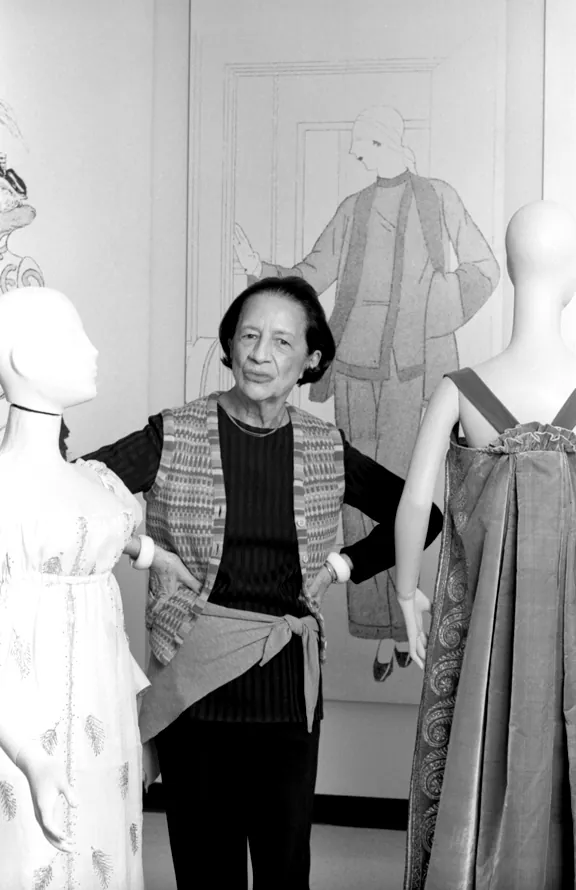
The form was invented in pieces. At Harper's Bazaar in the middle of the century, editor-in-chief Carmel Snow commissioned photographers the way other editors commissioned writers: she sent the 32-year-old Richard Avedon to Paris to photograph the fall couture, and gave fifteen of his pictures the run of the September 1955 issue as "Carmel Snow's Paris Report." Diana Vreeland, the magazine's fashion editor from 1936 to 1962, supplied the fantasy: her "Why Don't You...?" column told readers what to want before they knew they wanted it, and she carried the same logic into the pictures. She wanted images that gave readers, in her famous formulation, what they never knew they wanted. When she moved to Vogue as editor-in-chief, a post she held from 1963 to 1971, she took the doctrine with her, along with a taste for the theatrical that remade the magazine's pages.
Richard Avedon's Dovima with Elephants is the form's founding document in miniature. Taken at the Cirque d'Hiver in Paris in August 1955 and published in American Harper's Bazaar the following month, it was one of fifteen photographs Avedon made for "Carmel Snow's Paris Report," which ran across pages 204 to 217. The dress was designed for Dior by the nineteen-year-old Yves Saint Laurent. The picture does what the great editorials all do: it makes the clothes inseparable from the world around them, and it makes the world look like somewhere the reader has to be.
Irving Penn, who began photographing for Vogue in 1943, took the opposite route: the corner, the curtain, the model's gaze, nothing else. Over sixty years, more than 150 of his photographs appeared on the magazine's cover. The editorial could be a spectacle or a subtraction. What it could not be was filler. The pages were too expensive and the photographers too proud.
The economics were straightforward, and nobody pretended otherwise. The editorial sold the dream; the advertising paid for the paper. The September 2012 issue carried 658 pages of advertising. The editorial's job was to keep the reader inside the magazine long enough to meet them. This was the contract, and the best practitioners honored both sides of it: the pictures had to be good enough to justify the space, and the space had to be generous enough to let the pictures breathe.
The last great regime of the form belonged to Vogue Italia. From 1988 to May 2015, Steven Meisel photographed every cover of the magazine and, with editor-in-chief Franca Sozzani, set the tone of its lead features month after month: a twenty-seven-year run. When the June 2015 issue, devoted to China, arrived carrying the first covers not shot by Meisel, it read as the end of something. Sozzani died the following year, having led the magazine since 1988.
The digital image broke the sequence into singles. The editorial still exists, but it now competes with the feed, where every picture performs alone and the narrative arc is the reader's thumb. What the form taught remains, and it is worth keeping: fashion is not a garment but a narrative, and a narrative needs room. The twelve-page story was the room.