Portraiture
Fairyland: Tim Walker Builds a Queer Aristocracy
At the National Portrait Gallery, 250 specially created portraits turn five years of sittings into a history of activism, care, and becoming.
Four women sit in a row in an East Sussex field, in leather jackets and fishnets, each wearing a wig so tall it reads as architecture. The photograph is black and white, deadpan, and completely serious about its joke. That is the register of Tim Walker's Fairyland: Love and Legends, which opened at the National Portrait Gallery in London on 9 October 2026 and runs to 7 February 2027. The fantasy is real craft, and the craft is in service of a history.
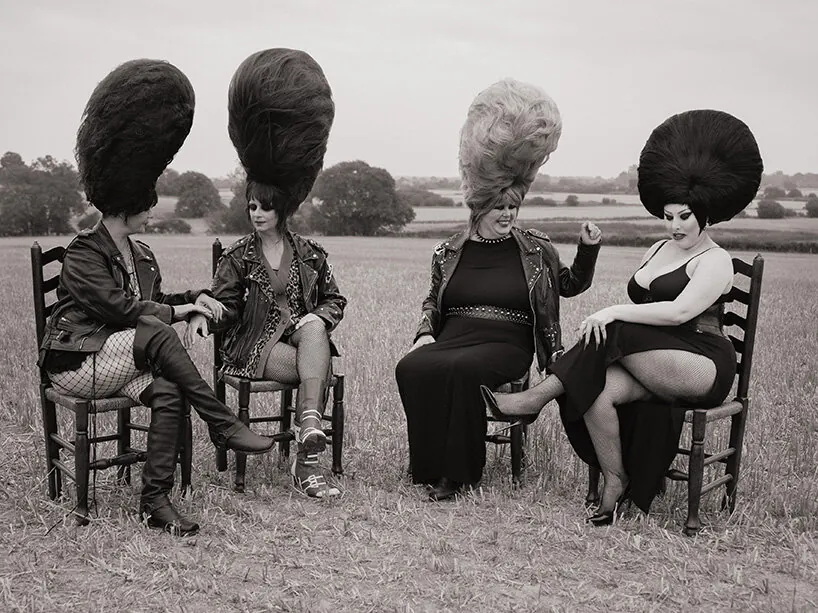
The exhibition brings together 250 specially created portraits, the result of five years Walker spent connecting with Queer people and their allies in Britain and beyond. The National Portrait Gallery describes the project as a decisive shift in his artistic focus. Walker came to prominence in the 1990s with a fantastical style of fashion photography, and his pictures and portraits have since appeared in Vogue, Vanity Fair, W, Love, Another Man and i-D. He has published seven books. Fairyland uses that same theatrical machinery, but the sitters are no longer selling a season. They are recording a community.
The show is curated by Susanna Brown and designed by Shona Heath, Walker's longtime collaborator. Its title reclaims a word once used as a slur, and the reclamation is the structure. The opening galleries belong to the trailblazers: people who spent the 1970s and 1980s advocating for the right to love, among them founding members of the Gay Liberation Front and Stonewall, including Olivette Cole-Wilson, Andrew Lumsden, Lisa Power and Tom Robinson. Walker photographs this generation in a style inspired by sixteenth-century Tudor portraiture, by Hans Holbein the Younger and Nicholas Hilliard, building what the gallery calls his own queeristocracy: the marginalised placed inside the visual language of power and official remembrance.
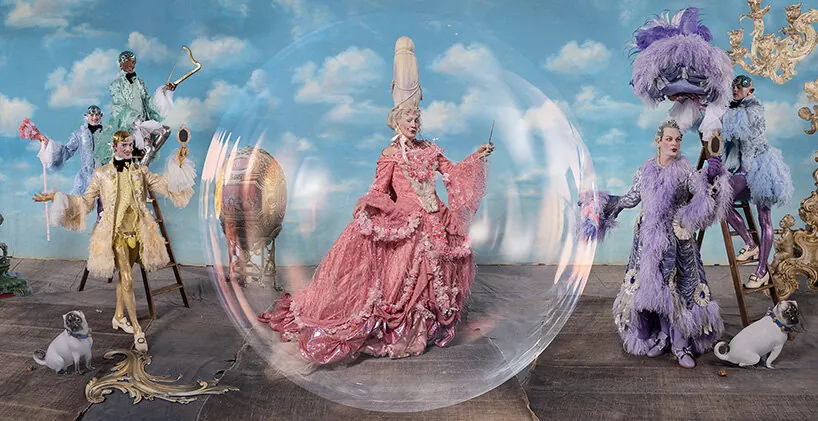
The portrait of Paul O'Grady and Julian Clary as the Glitter Queens, made in London in 2022 with a court of attendants in period costume around a great transparent bubble, shows how the method works. It is pantomime and state portrait at once. Nothing in the frame apologises for the artifice, because the artifice is the argument: these sitters built public selves out of costume, timing, and nerve, and Walker honours the building rather than stripping it away.
A second group of sitters brings the story forward: campaigners and changemakers such as Ted Brown, Caroline Paige, Gilli Salvat and Peter Tatchell, set alongside storytellers including James Ivory and Sarah Waters. Walker asked each sitter to bring a meaningful object to the session. Jane Cholmeley brought the original shop sign from Silver Moon Women's Bookshop, which she founded in 1984. Sunil Gupta holds a camera. Isaac Julien clasps a conch shell, a motif from his 1989 film Looking for Langston. The objects do quiet, documentary work inside the fantasy: a shop sign, a camera, and a shell carry whole institutions and careers into a single frame.
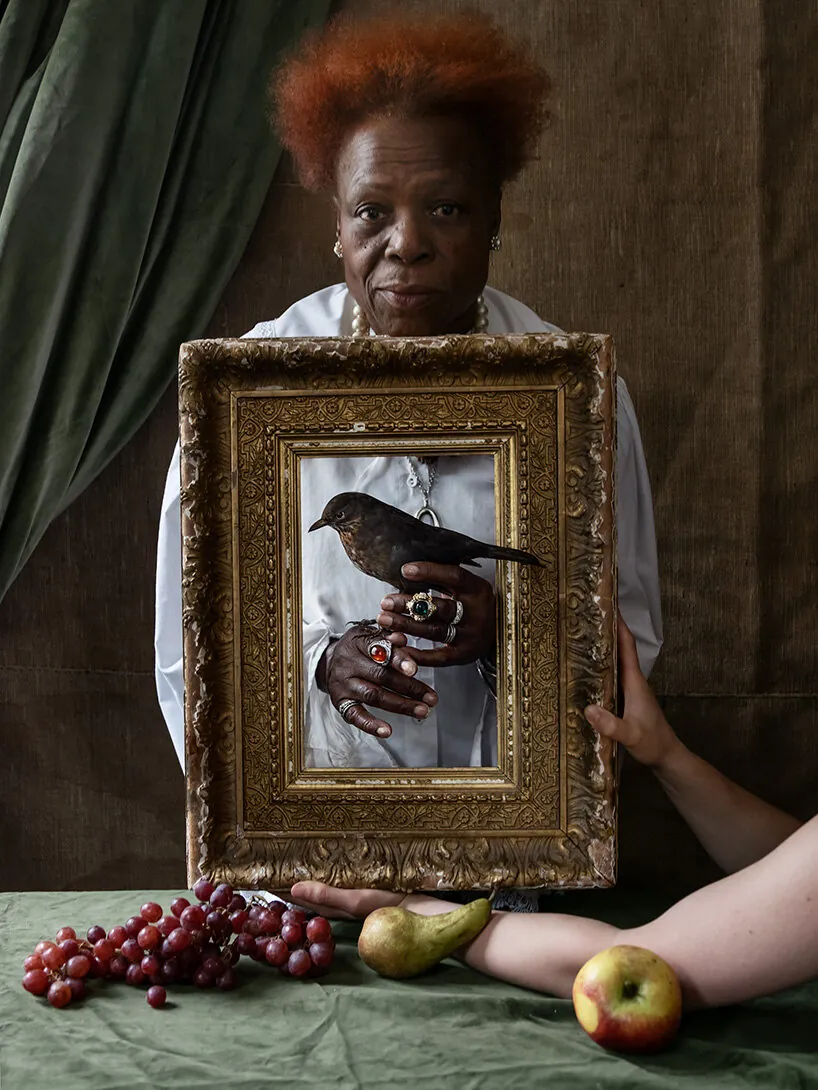
Olivette Cole-Wilson's portrait, made in London in 2025, holds a blackbird inside a gilt frame, fruit arranged on the table in front of her like a still life that has decided to include its painter. It is a good example of the late Walker manner: the prop is not decoration, it is biography staged as emblem. Nearly all of one sequence of portraits, the gallery notes, is set against deceptively simple white backgrounds, in a style reminiscent of Richard Avedon, whom Walker assisted in the 1990s. The white ground and the Tudor frame turn out to be the same device at different temperatures: a way of saying the sitter matters before the sitter says anything.
At the centre of the exhibition is its hardest room, and its most tender. One section pays tribute to the solidarity that answered the HIV and AIDS crisis of the 1980s: nurses and healthcare professionals who helped develop effective treatments, shown alongside musicians who soundtracked the era, including Marc Almond, Holly Johnson and Jimmy Somerville. Nearby, a room of large-scale portraits of the Rebel Dykes, a post-punk collective, takes its cue from Karlheinz Weinberger's photographs of 1960s biker gangs, and a short film lets the women reflect on community and on campaigns for nuclear disarmament, environmentalism, sex positive feminism and HIV solidarity. Walker has said he wanted to bring the disco to the ward. In context, the line is not flippant. It insists that joy was part of the care, and that the care deserves the same scale as the loss.
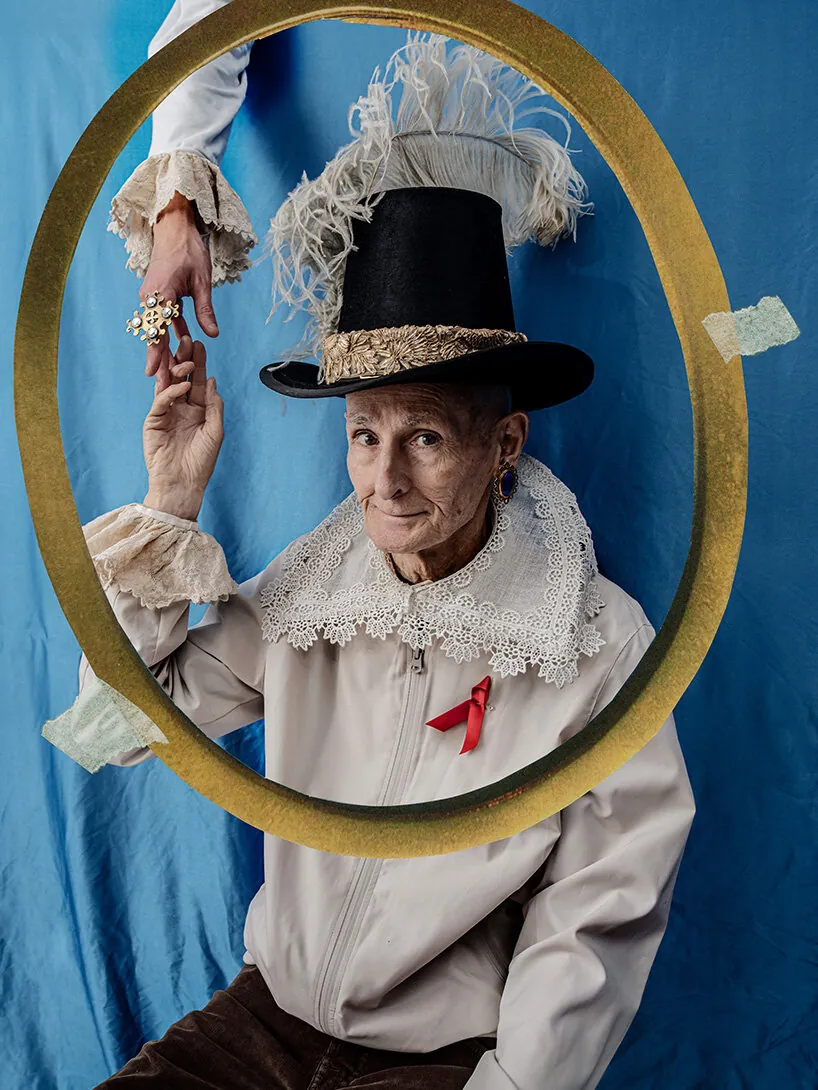
Andrew Lumsden, who died in 2023, appears inside a gold oval after Nicholas Hilliard, in a tall feathered hat and a lace collar, a red ribbon pinned at his chest, one hand raised to meet another hand entering the frame. It is a miniature enlarged into a monument, and it may be the exhibition's clearest statement of intent. Portraiture has always decided who is remembered and in what costume. Fairyland simply makes the decision openly, and makes it for people the national collection was not built to hold.
The second half of the show turns to fashion, makeup and performance as instruments of self-invention: designers Jean Paul Gaultier and Michaela Stark, drag performers including David Hoyle and Midgitte Bardot, actors Ncuti Gatwa, Hunter Schafer, Fiona Shaw and Ben Whishaw, and musicians Björk, Lady Gaga, Frank Ocean and Chappell Roan. It closes with staged scenes that rework fairy tales and nursery rhymes. A 320-page catalogue accompanies the exhibition, with essays by Travis Alabanza, Russell T Davies, Shon Faye, Lisa Power and Joelle Taylor, and an extended interview between Walker and Brown.
Walker frames the project as placing himself in the queer realm with confidence, and as a message to visitors who feel alone. Stripped of its wigs and bubbles, Fairyland is an argument about what a sitting is for: an act of trust recorded in public. Two hundred and fifty of them amount to a census of a community, taken by one of its own, in the rooms where the nation keeps its faces.